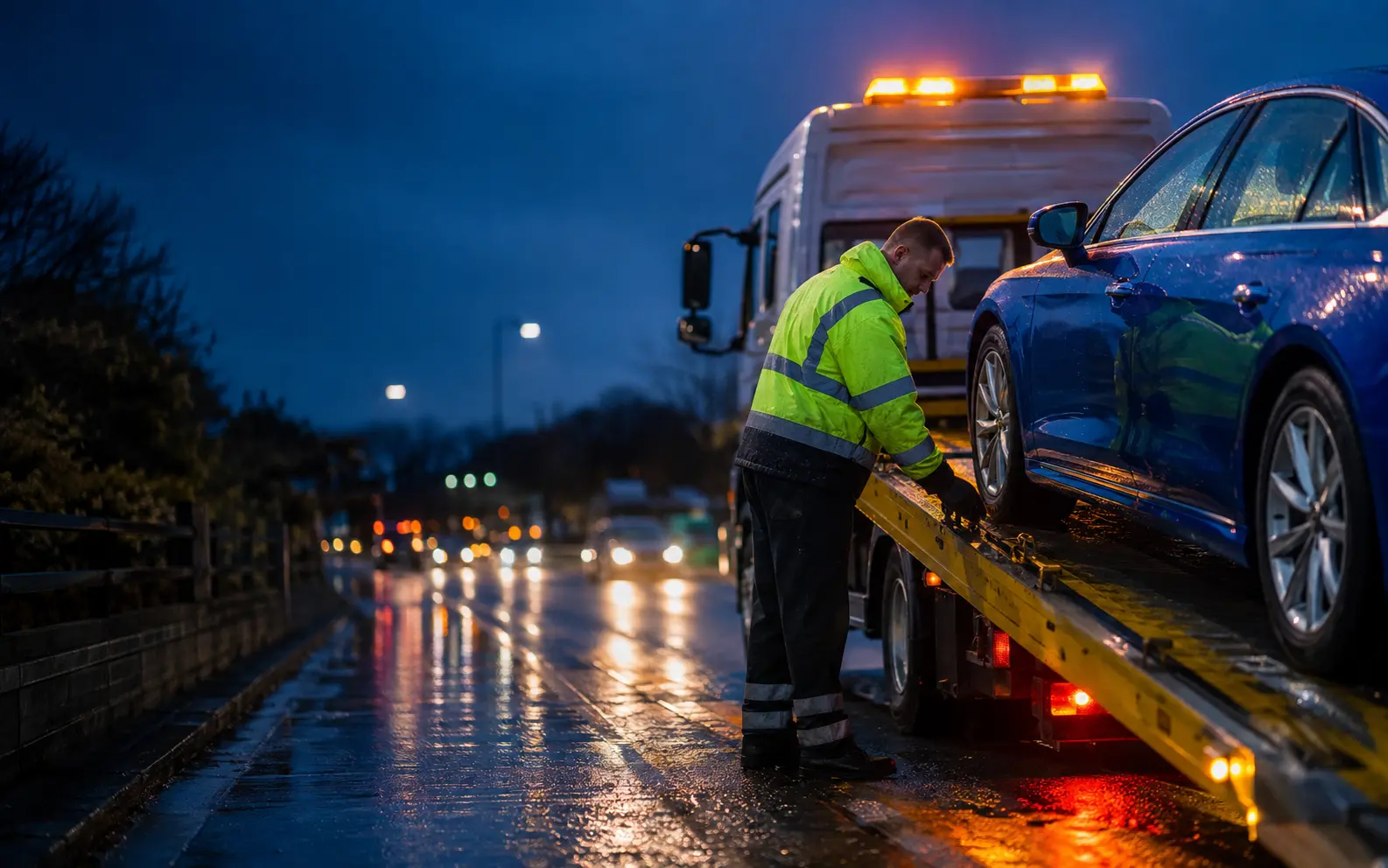
Choose the recovery route that fits the vehicle
Accident damage can affect steering, wheel movement and safe loading points. Describe visible damage without entering live traffic to obtain a photograph. Our accident recovery service explains the information needed to plan that work.
For the location discussed in this article, see recovery coverage in Carlton. Availability and access are confirmed with dispatch.
For a connected planning question, read Article: What to photograph for an insurance claim — Clifton.
For a connected planning question, read Article: What happens during an accident recovery — Kirkby-in-Ashfield.
what happens during an accident recovery in Carlton should be arranged from the facts of the vehicle and scene: protect people first, give the exact location, identify the vehicle, explain whether it starts, rolls, steers and can leave Park, and confirm a destination that can receive it. This editorial guide explains how to prepare that information, where specialist planning may be needed and which decisions remain with the attending operator, road authority, insurer, owner or receiving garage.
Explore this page
What what happens during an accident recovery means for this page without unsafe assumptions
This part of the service information matters because a small missing detail can change the vehicle, equipment or route needed. In this editorial guide, what happens during an accident recovery in Carlton is considered as accident-damaged and non-standard vehicle recovery. The first useful observations include wheel angles, suspension position, broken glass, leaking fluid, loose panels, airbag deployment, police instructions and the authority to release the vehicle. Start by defining the intended outcome rather than choosing a technical label from a list. The useful facts are the vehicle’s condition, its position, the people involved and the destination that can receive it.
Local access may involve residential drives, retail car parks, industrial access roads, school-time traffic and routes that change character quickly, but the actual road, entrance, bay, direction and safe working position must be described rather than inferred from the place name. Changes in wheel movement, police instructions, keys or destination should update the same dispatch record rather than start a conflicting message thread. That approach keeps the conversation short without removing the detail that affects safety, access or handover.
Practical steps for what happens during an accident recovery in Carlton
Applied to what happens during an accident recovery in Carlton, the task is to convert the available information into one current instruction. Describe what you can observe in ordinary language and let dispatch decide which questions affect loading. The working method is scene-led collection with damaged components identified before winching, loading and handover. For this address, collection and destination access should be described separately because each end may require a different approach. State what is known, mark what has not been safely checked, name the person who can approve a change and confirm the destination contact who will accept the vehicle.
A clear brief protects the vehicle and also prevents a receiver being surprised by damage, locked wheels or an unattended delivery. It preserves a clear boundary between information supplied by the customer and decisions made by the responsible operator.
Limits, evidence and the next decision
The limit is as important as the action on this editorial guide. A website description cannot diagnose a fault or guarantee that a specific vehicle, scene or journey is suitable. For accident-damaged and non-standard vehicle recovery, avoid approaching unstable damage, moving loose parts, entering a controlled scene or sending the vehicle to a destination that cannot receive it. General online information cannot authorise entry to a controlled scene, establish ownership, select equipment for an unseen vehicle, manage live traffic or diagnose the underlying fault. Keep the decision tied to the current scene in Carlton, the vehicle as found, the operator's assessment and the agreed destination.
The description should distinguish facts seen by the caller from conclusions that require the recovery operator or repairer. Using the same facts throughout the job reduces avoidable waiting and makes any later change easier to explain.
Put personal safety before the vehicle before dispatch
A careful booking treats this issue as an operational question rather than a phrase copied from a service menu. In this editorial guide, what happens during an accident recovery in Carlton is considered as accident-damaged and non-standard vehicle recovery. The first useful observations include wheel angles, suspension position, broken glass, leaking fluid, loose panels, airbag deployment, police instructions and the authority to release the vehicle. Roadside decisions begin with people, traffic and immediate hazards, not photographs or mechanical investigation. Live lanes, fast traffic, poor visibility, unstable damage, smoke, fire, water and spilled fluids can all change what is safe to do.
Local access may involve residential drives, retail car parks, industrial access roads, school-time traffic and routes that change character quickly, but the actual road, entrance, bay, direction and safe working position must be described rather than inferred from the place name. Where the caller is not the owner, authority, release references and payment approval should be resolved before movement is assumed. It preserves a clear boundary between information supplied by the customer and decisions made by the responsible operator.
Practical steps for what happens during an accident recovery in Carlton
Applied to what happens during an accident recovery in Carlton, the task is to convert the available information into one current instruction. Move to a place of relative safety when possible, follow police or traffic-officer instructions and call emergency services where life is at risk. The working method is scene-led collection with damaged components identified before winching, loading and handover. For this address, collection and destination access should be described separately because each end may require a different approach. State what is known, mark what has not been safely checked, name the person who can approve a change and confirm the destination contact who will accept the vehicle.
A clear brief protects the vehicle and also prevents a receiver being surprised by damage, locked wheels or an unattended delivery. The result is a record that the driver, dispatcher, payer and receiver can all understand in the same way.
Limits, evidence and the next decision
The limit is as important as the action on this editorial guide. Do not walk into traffic, crawl under a vehicle, stand between the vehicle and approaching traffic or attempt an unsafe repair to help a booking. For accident-damaged and non-standard vehicle recovery, avoid approaching unstable damage, moving loose parts, entering a controlled scene or sending the vehicle to a destination that cannot receive it. General online information cannot authorise entry to a controlled scene, establish ownership, select equipment for an unseen vehicle, manage live traffic or diagnose the underlying fault.
Keep the decision tied to the current scene in Carlton, the vehicle as found, the operator's assessment and the agreed destination. The collection point and delivery point should be treated as separate access checks, even when both are within Carlton. This is more useful than trying to predict the equipment or diagnose the fault before anyone has assessed it.
Describe the exact collection point in Carlton before dispatch
The safest plan is usually the one that makes uncertainty visible before the recovery vehicle is committed. In this editorial guide, what happens during an accident recovery in Carlton is considered as accident-damaged and non-standard vehicle recovery. The first useful observations include wheel angles, suspension position, broken glass, leaking fluid, loose panels, airbag deployment, police instructions and the authority to release the vehicle. A town name or postcode can cover several roads, entrances and carriageways, so it is only the beginning of the location brief.
Direction of travel, nearest junction, building entrance, car-park level, bay number, gate, landmark and safe meeting point may determine the approach. Local access may involve residential drives, retail car parks, industrial access roads, school-time traffic and routes that change character quickly, but the actual road, entrance, bay, direction and safe working position must be described rather than inferred from the place name. A clear brief protects the vehicle and also prevents a receiver being surprised by damage, locked wheels or an unattended delivery. This is more useful than trying to predict the equipment or diagnose the fault before anyone has assessed it.
Practical steps for what happens during an accident recovery in Carlton
Applied to what happens during an accident recovery in Carlton, the task is to convert the available information into one current instruction. Share a pin and then correct it in words if it lands on the wrong side of a dual carriageway or at a pedestrian entrance. The working method is scene-led collection with damaged components identified before winching, loading and handover. For this address, collection and destination access should be described separately because each end may require a different approach. State what is known, mark what has not been safely checked, name the person who can approve a change and confirm the destination contact who will accept the vehicle.
A clear brief protects the vehicle and also prevents a receiver being surprised by damage, locked wheels or an unattended delivery. That approach keeps the conversation short without removing the detail that affects safety, access or handover.
Limits, evidence and the next decision
The limit is as important as the action on this editorial guide. Never cross a road or leave a safe position merely to improve a pin, read a marker or photograph the vehicle. For accident-damaged and non-standard vehicle recovery, avoid approaching unstable damage, moving loose parts, entering a controlled scene or sending the vehicle to a destination that cannot receive it. General online information cannot authorise entry to a controlled scene, establish ownership, select equipment for an unseen vehicle, manage live traffic or diagnose the underlying fault.
Keep the decision tied to the current scene in Carlton, the vehicle as found, the operator's assessment and the agreed destination. Where the caller is not the owner, authority, release references and payment approval should be resolved before movement is assumed. Using the same facts throughout the job reduces avoidable waiting and makes any later change easier to explain.
Identify the actual vehicle without guessing
For a driver, family member or fleet contact, this is where a vague request becomes an organised recovery brief. In this editorial guide, what happens during an accident recovery in Carlton is considered as accident-damaged and non-standard vehicle recovery. The first useful observations include wheel angles, suspension position, broken glass, leaking fluid, loose panels, airbag deployment, police instructions and the authority to release the vehicle. Registration, make and model help distinguish dimensions, drivetrain, controls, kerb weight and manufacturer recovery instructions. Body conversions, lowered suspension, roof equipment, camper interiors, trailers, heavy loads and missing trim can change the job even when the badge is familiar.
Local access may involve residential drives, retail car parks, industrial access roads, school-time traffic and routes that change character quickly, but the actual road, entrance, bay, direction and safe working position must be described rather than inferred from the place name. The description should distinguish facts seen by the caller from conclusions that require the recovery operator or repairer. Using the same facts throughout the job reduces avoidable waiting and makes any later change easier to explain.
Practical steps for what happens during an accident recovery in Carlton
Applied to what happens during an accident recovery in Carlton, the task is to convert the available information into one current instruction. State whether it is electric, hybrid, automatic, manual, all-wheel drive, a van, motorcycle or modified vehicle, and mention what is carried. The working method is scene-led collection with damaged components identified before winching, loading and handover. For this address, collection and destination access should be described separately because each end may require a different approach. State what is known, mark what has not been safely checked, name the person who can approve a change and confirm the destination contact who will accept the vehicle.
The collection point and delivery point should be treated as separate access checks, even when both are within Carlton. Using the same facts throughout the job reduces avoidable waiting and makes any later change easier to explain.
Limits, evidence and the next decision
The limit is as important as the action on this editorial guide. Do not estimate equipment suitability from appearance or assume that a service name confirms capacity. For accident-damaged and non-standard vehicle recovery, avoid approaching unstable damage, moving loose parts, entering a controlled scene or sending the vehicle to a destination that cannot receive it. General online information cannot authorise entry to a controlled scene, establish ownership, select equipment for an unseen vehicle, manage live traffic or diagnose the underlying fault. Keep the decision tied to the current scene in Carlton, the vehicle as found, the operator's assessment and the agreed destination.
The collection point and delivery point should be treated as separate access checks, even when both are within Carlton. The result is a record that the driver, dispatcher, payer and receiver can all understand in the same way.
Report symptoms in the order they happened: the practical decision
The practical value of this section is that it turns a broad enquiry into facts the operator can use. In this editorial guide, what happens during an accident recovery in Carlton is considered as accident-damaged and non-standard vehicle recovery. The first useful observations include wheel angles, suspension position, broken glass, leaking fluid, loose panels, airbag deployment, police instructions and the authority to release the vehicle. A short sequence of events is more reliable than a guessed component failure. Warning lights, noises, smells, loss of power, impact, overheating, charging problems, refuelling and previous repair attempts all provide different planning clues.
Local access may involve residential drives, retail car parks, industrial access roads, school-time traffic and routes that change character quickly, but the actual road, entrance, bay, direction and safe working position must be described rather than inferred from the place name. Where the caller is not the owner, authority, release references and payment approval should be resolved before movement is assumed. The result is a record that the driver, dispatcher, payer and receiver can all understand in the same way.
Practical steps for what happens during an accident recovery in Carlton
Applied to what happens during an accident recovery in Carlton, the task is to convert the available information into one current instruction. Explain what happened immediately before the vehicle stopped, what controls still work and what has changed since the first call. The working method is scene-led collection with damaged components identified before winching, loading and handover. For this address, collection and destination access should be described separately because each end may require a different approach. State what is known, mark what has not been safely checked, name the person who can approve a change and confirm the destination contact who will accept the vehicle.
The collection point and delivery point should be treated as separate access checks, even when both are within Carlton. This is more useful than trying to predict the equipment or diagnose the fault before anyone has assessed it.
Limits, evidence and the next decision
The limit is as important as the action on this editorial guide. Avoid repeating a diagnosis as fact unless it came from a person who inspected the vehicle and is responsible for that diagnosis. For accident-damaged and non-standard vehicle recovery, avoid approaching unstable damage, moving loose parts, entering a controlled scene or sending the vehicle to a destination that cannot receive it. General online information cannot authorise entry to a controlled scene, establish ownership, select equipment for an unseen vehicle, manage live traffic or diagnose the underlying fault.
Keep the decision tied to the current scene in Carlton, the vehicle as found, the operator's assessment and the agreed destination. A driver reporting the incident, a fleet contact approving cost and a garage receiving the vehicle may each hold a different part of the information. The result is a record that the driver, dispatcher, payer and receiver can all understand in the same way.
Separate starting, rolling, steering and braking: the practical decision
The safest plan is usually the one that makes uncertainty visible before the recovery vehicle is committed. In this editorial guide, what happens during an accident recovery in Carlton is considered as accident-damaged and non-standard vehicle recovery. The first useful observations include wheel angles, suspension position, broken glass, leaking fluid, loose panels, airbag deployment, police instructions and the authority to release the vehicle. A vehicle can start but remain impossible to load normally, or fail to start while still rolling and steering freely. Wheel movement, steering lock, parking brake, selector position, tyre condition, suspension damage and bodywork contact each affect the loading method.
Local access may involve residential drives, retail car parks, industrial access roads, school-time traffic and routes that change character quickly, but the actual road, entrance, bay, direction and safe working position must be described rather than inferred from the place name. Where the caller is not the owner, authority, release references and payment approval should be resolved before movement is assumed. It preserves a clear boundary between information supplied by the customer and decisions made by the responsible operator.
Practical steps for what happens during an accident recovery in Carlton
Applied to what happens during an accident recovery in Carlton, the task is to convert the available information into one current instruction. Tell dispatch which movements are known and which are unknown; do not carry out a risky test solely to provide an answer. The working method is scene-led collection with damaged components identified before winching, loading and handover. For this address, collection and destination access should be described separately because each end may require a different approach. State what is known, mark what has not been safely checked, name the person who can approve a change and confirm the destination contact who will accept the vehicle.
The collection point and delivery point should be treated as separate access checks, even when both are within Carlton. That approach keeps the conversation short without removing the detail that affects safety, access or handover.
Limits, evidence and the next decision
The limit is as important as the action on this editorial guide. Never force a selector, release an electronic brake by guesswork or drag a wheel because an online instruction appears to fit another model. For accident-damaged and non-standard vehicle recovery, avoid approaching unstable damage, moving loose parts, entering a controlled scene or sending the vehicle to a destination that cannot receive it. General online information cannot authorise entry to a controlled scene, establish ownership, select equipment for an unseen vehicle, manage live traffic or diagnose the underlying fault.
Keep the decision tied to the current scene in Carlton, the vehicle as found, the operator's assessment and the agreed destination. A driver reporting the incident, a fleet contact approving cost and a garage receiving the vehicle may each hold a different part of the information. The result is a record that the driver, dispatcher, payer and receiver can all understand in the same way.
Choose a destination that can receive the vehicle: the practical decision
The practical value of this section is that it turns a broad enquiry into facts the operator can use. In this editorial guide, what happens during an accident recovery in Carlton is considered as accident-damaged and non-standard vehicle recovery. The first useful observations include wheel angles, suspension position, broken glass, leaking fluid, loose panels, airbag deployment, police instructions and the authority to release the vehicle. A recovery journey needs an agreed unloading point and a person or business able to accept the vehicle in its current condition.
Opening hours, gate access, driveway space, workshop capacity, storage rules and whether a non-runner can be left all affect the handover. Local access may involve residential drives, retail car parks, industrial access roads, school-time traffic and routes that change character quickly, but the actual road, entrance, bay, direction and safe working position must be described rather than inferred from the place name. Changes in wheel movement, police instructions, keys or destination should update the same dispatch record rather than start a conflicting message thread. This is more useful than trying to predict the equipment or diagnose the fault before anyone has assessed it.
Practical steps for what happens during an accident recovery in Carlton
Applied to what happens during an accident recovery in Carlton, the task is to convert the available information into one current instruction. Give the delivery postcode, receiver’s name, contact number and instructions, and confirm alternatives before the truck departs. The working method is scene-led collection with damaged components identified before winching, loading and handover. For this address, collection and destination access should be described separately because each end may require a different approach. State what is known, mark what has not been safely checked, name the person who can approve a change and confirm the destination contact who will accept the vehicle.
A driver reporting the incident, a fleet contact approving cost and a garage receiving the vehicle may each hold a different part of the information. Using the same facts throughout the job reduces avoidable waiting and makes any later change easier to explain.
Limits, evidence and the next decision
The limit is as important as the action on this editorial guide. Do not assume a closed garage, roadside address or unattended property can accept the vehicle simply because it is the preferred destination. For accident-damaged and non-standard vehicle recovery, avoid approaching unstable damage, moving loose parts, entering a controlled scene or sending the vehicle to a destination that cannot receive it. General online information cannot authorise entry to a controlled scene, establish ownership, select equipment for an unseen vehicle, manage live traffic or diagnose the underlying fault.
Keep the decision tied to the current scene in Carlton, the vehicle as found, the operator's assessment and the agreed destination. The description should distinguish facts seen by the caller from conclusions that require the recovery operator or repairer. Using the same facts throughout the job reduces avoidable waiting and makes any later change easier to explain.
Compare the complete recovery quote: the practical decision
This part of the service information matters because a small missing detail can change the vehicle, equipment or route needed. In this editorial guide, what happens during an accident recovery in Carlton is considered as accident-damaged and non-standard vehicle recovery. The first useful observations include wheel angles, suspension position, broken glass, leaking fluid, loose panels, airbag deployment, police instructions and the authority to release the vehicle. A useful quote relates to the described collection, vehicle condition, loading method, route and unloading arrangement. Waiting, restricted access, skates, controlled winching, additional mileage, storage, changed destinations and out-of-hours handover may alter the scope.
Local access may involve residential drives, retail car parks, industrial access roads, school-time traffic and routes that change character quickly, but the actual road, entrance, bay, direction and safe working position must be described rather than inferred from the place name. A clear brief protects the vehicle and also prevents a receiver being surprised by damage, locked wheels or an unattended delivery. That approach keeps the conversation short without removing the detail that affects safety, access or handover.
Practical steps for what happens during an accident recovery in Carlton
Applied to what happens during an accident recovery in Carlton, the task is to convert the available information into one current instruction. Ask what is included, whether the figure is fixed for the stated facts and who can approve a change during the job. The working method is scene-led collection with damaged components identified before winching, loading and handover. For this address, collection and destination access should be described separately because each end may require a different approach. State what is known, mark what has not been safely checked, name the person who can approve a change and confirm the destination contact who will accept the vehicle.
Changes in wheel movement, police instructions, keys or destination should update the same dispatch record rather than start a conflicting message thread. Using the same facts throughout the job reduces avoidable waiting and makes any later change easier to explain.
Limits, evidence and the next decision
The limit is as important as the action on this editorial guide. A generic starting price cannot represent every vehicle or scene, and transport does not automatically include repair or storage. For accident-damaged and non-standard vehicle recovery, avoid approaching unstable damage, moving loose parts, entering a controlled scene or sending the vehicle to a destination that cannot receive it. General online information cannot authorise entry to a controlled scene, establish ownership, select equipment for an unseen vehicle, manage live traffic or diagnose the underlying fault.
Keep the decision tied to the current scene in Carlton, the vehicle as found, the operator's assessment and the agreed destination. The description should distinguish facts seen by the caller from conclusions that require the recovery operator or repairer. That approach keeps the conversation short without removing the detail that affects safety, access or handover.
Complete a clear vehicle handover
For a driver, family member or fleet contact, this is where a vague request becomes an organised recovery brief. In this editorial guide, what happens during an accident recovery in Carlton is considered as accident-damaged and non-standard vehicle recovery. The first useful observations include wheel angles, suspension position, broken glass, leaking fluid, loose panels, airbag deployment, police instructions and the authority to release the vehicle. Recovery is not finished merely because the truck reaches a postcode. The receiver should know the vehicle is a non-runner or damaged, understand where it will be placed and accept keys and relevant documents.
Local access may involve residential drives, retail car parks, industrial access roads, school-time traffic and routes that change character quickly, but the actual road, entrance, bay, direction and safe working position must be described rather than inferred from the place name. The description should distinguish facts seen by the caller from conclusions that require the recovery operator or repairer. This is more useful than trying to predict the equipment or diagnose the fault before anyone has assessed it.
Practical steps for what happens during an accident recovery in Carlton
Applied to what happens during an accident recovery in Carlton, the task is to convert the available information into one current instruction. Record the receiving person, unloading position, key transfer and any condition note or receipt supplied for the movement. The working method is scene-led collection with damaged components identified before winching, loading and handover. For this address, collection and destination access should be described separately because each end may require a different approach. State what is known, mark what has not been safely checked, name the person who can approve a change and confirm the destination contact who will accept the vehicle.
The collection point and delivery point should be treated as separate access checks, even when both are within Carlton. It preserves a clear boundary between information supplied by the customer and decisions made by the responsible operator.
Limits, evidence and the next decision
The limit is as important as the action on this editorial guide. Diagnosis, parts, repair completion and storage charges belong to the receiving provider unless expressly included in the recovery agreement. For accident-damaged and non-standard vehicle recovery, avoid approaching unstable damage, moving loose parts, entering a controlled scene or sending the vehicle to a destination that cannot receive it. General online information cannot authorise entry to a controlled scene, establish ownership, select equipment for an unseen vehicle, manage live traffic or diagnose the underlying fault.
Keep the decision tied to the current scene in Carlton, the vehicle as found, the operator's assessment and the agreed destination. The description should distinguish facts seen by the caller from conclusions that require the recovery operator or repairer. The result is a record that the driver, dispatcher, payer and receiver can all understand in the same way.
Understand the loading and restraint decision without unsafe assumptions
A reliable way to approach this part of the decision is to separate observation from assumption. In this editorial guide, what happens during an accident recovery in Carlton is considered as accident-damaged and non-standard vehicle recovery. The first useful observations include wheel angles, suspension position, broken glass, leaking fluid, loose panels, airbag deployment, police instructions and the authority to release the vehicle. Loading is controlled movement onto suitable equipment, followed by restraint appropriate to the vehicle and journey. Ground clearance, wheel condition, towing points, weight, load distribution, body damage and manufacturer instructions influence the method.
Local access may involve residential drives, retail car parks, industrial access roads, school-time traffic and routes that change character quickly, but the actual road, entrance, bay, direction and safe working position must be described rather than inferred from the place name. Changes in wheel movement, police instructions, keys or destination should update the same dispatch record rather than start a conflicting message thread. It also gives the attending operator a clear basis for checking the plan against the actual scene.
Practical steps for what happens during an accident recovery in Carlton
Applied to what happens during an accident recovery in Carlton, the task is to convert the available information into one current instruction. Tell the operator about any change noticed on arrival and allow the attending professional to assess the scene before movement begins. The working method is scene-led collection with damaged components identified before winching, loading and handover. For this address, collection and destination access should be described separately because each end may require a different approach. State what is known, mark what has not been safely checked, name the person who can approve a change and confirm the destination contact who will accept the vehicle.
A clear brief protects the vehicle and also prevents a receiver being surprised by damage, locked wheels or an unattended delivery. It also gives the attending operator a clear basis for checking the plan against the actual scene.
Limits, evidence and the next decision
The limit is as important as the action on this editorial guide. Website content cannot specify a universal winching point, strap position, skate arrangement or towing method for every vehicle. For accident-damaged and non-standard vehicle recovery, avoid approaching unstable damage, moving loose parts, entering a controlled scene or sending the vehicle to a destination that cannot receive it. General online information cannot authorise entry to a controlled scene, establish ownership, select equipment for an unseen vehicle, manage live traffic or diagnose the underlying fault. Keep the decision tied to the current scene in Carlton, the vehicle as found, the operator's assessment and the agreed destination.
A driver reporting the incident, a fleet contact approving cost and a garage receiving the vehicle may each hold a different part of the information. The result is a record that the driver, dispatcher, payer and receiver can all understand in the same way.
Keep a proportionate record: the practical decision
The practical value of this section is that it turns a broad enquiry into facts the operator can use. In this editorial guide, what happens during an accident recovery in Carlton is considered as accident-damaged and non-standard vehicle recovery. The first useful observations include wheel angles, suspension position, broken glass, leaking fluid, loose panels, airbag deployment, police instructions and the authority to release the vehicle. A simple factual record helps with payment, insurance, fleet administration and questions raised after delivery. Useful records include the agreed route, quote basis, contacts, release reference, key handover, receipt and safe photographs of pre-existing damage.
Local access may involve residential drives, retail car parks, industrial access roads, school-time traffic and routes that change character quickly, but the actual road, entrance, bay, direction and safe working position must be described rather than inferred from the place name. A driver reporting the incident, a fleet contact approving cost and a garage receiving the vehicle may each hold a different part of the information. It preserves a clear boundary between information supplied by the customer and decisions made by the responsible operator.
Practical steps for what happens during an accident recovery in Carlton
Applied to what happens during an accident recovery in Carlton, the task is to convert the available information into one current instruction. Store only what is needed, correct inaccuracies promptly and raise transport questions with the recovery provider using the agreed facts. The working method is scene-led collection with damaged components identified before winching, loading and handover. For this address, collection and destination access should be described separately because each end may require a different approach. State what is known, mark what has not been safely checked, name the person who can approve a change and confirm the destination contact who will accept the vehicle.
The description should distinguish facts seen by the caller from conclusions that require the recovery operator or repairer. It preserves a clear boundary between information supplied by the customer and decisions made by the responsible operator.
Limits, evidence and the next decision
The limit is as important as the action on this editorial guide. Do not publish personal data, third-party vehicle details or unverified allegations in reviews or public messages. For accident-damaged and non-standard vehicle recovery, avoid approaching unstable damage, moving loose parts, entering a controlled scene or sending the vehicle to a destination that cannot receive it. General online information cannot authorise entry to a controlled scene, establish ownership, select equipment for an unseen vehicle, manage live traffic or diagnose the underlying fault. Keep the decision tied to the current scene in Carlton, the vehicle as found, the operator's assessment and the agreed destination.
A clear brief protects the vehicle and also prevents a receiver being surprised by damage, locked wheels or an unattended delivery. It also gives the attending operator a clear basis for checking the plan against the actual scene.
Distinguish urgent recovery from planned transport
A reliable way to approach this part of the decision is to separate observation from assumption. In this editorial guide, what happens during an accident recovery in Carlton is considered as accident-damaged and non-standard vehicle recovery. The first useful observations include wheel angles, suspension position, broken glass, leaking fluid, loose panels, airbag deployment, police instructions and the authority to release the vehicle. A breakdown requires immediate safety and availability decisions, while a planned move begins with readiness, release and timetable. Auction collections, garage transfers, purchased vehicles and event movements can fail if keys, payment or receiving access are not confirmed.
Local access may involve residential drives, retail car parks, industrial access roads, school-time traffic and routes that change character quickly, but the actual road, entrance, bay, direction and safe working position must be described rather than inferred from the place name. A driver reporting the incident, a fleet contact approving cost and a garage receiving the vehicle may each hold a different part of the information. It preserves a clear boundary between information supplied by the customer and decisions made by the responsible operator.
Practical steps for what happens during an accident recovery in Carlton
Applied to what happens during an accident recovery in Carlton, the task is to convert the available information into one current instruction. Choose the route that matches the actual purpose and give a preferred window only after both ends are ready. The working method is scene-led collection with damaged components identified before winching, loading and handover. For this address, collection and destination access should be described separately because each end may require a different approach. State what is known, mark what has not been safely checked, name the person who can approve a change and confirm the destination contact who will accept the vehicle.
A driver reporting the incident, a fleet contact approving cost and a garage receiving the vehicle may each hold a different part of the information. That approach keeps the conversation short without removing the detail that affects safety, access or handover.
Limits, evidence and the next decision
The limit is as important as the action on this editorial guide. A scheduled transport slot is not a promise that an unready or inaccurately described vehicle can be collected without changes. For accident-damaged and non-standard vehicle recovery, avoid approaching unstable damage, moving loose parts, entering a controlled scene or sending the vehicle to a destination that cannot receive it. General online information cannot authorise entry to a controlled scene, establish ownership, select equipment for an unseen vehicle, manage live traffic or diagnose the underlying fault.
Keep the decision tied to the current scene in Carlton, the vehicle as found, the operator's assessment and the agreed destination. A clear brief protects the vehicle and also prevents a receiver being surprised by damage, locked wheels or an unattended delivery. It also gives the attending operator a clear basis for checking the plan against the actual scene.
Coordinate fleet and business recovery before dispatch
A careful booking treats this issue as an operational question rather than a phrase copied from a service menu. In this editorial guide, what happens during an accident recovery in Carlton is considered as accident-damaged and non-standard vehicle recovery. The first useful observations include wheel angles, suspension position, broken glass, leaking fluid, loose panels, airbag deployment, police instructions and the authority to release the vehicle. Commercial downtime is managed better when operational and payment decisions have named owners. The driver may provide the live location while a fleet manager approves cost, a garage accepts delivery and an accounts team needs a purchase order.
Local access may involve residential drives, retail car parks, industrial access roads, school-time traffic and routes that change character quickly, but the actual road, entrance, bay, direction and safe working position must be described rather than inferred from the place name. A driver reporting the incident, a fleet contact approving cost and a garage receiving the vehicle may each hold a different part of the information. It preserves a clear boundary between information supplied by the customer and decisions made by the responsible operator.
Practical steps for what happens during an accident recovery in Carlton
Applied to what happens during an accident recovery in Carlton, the task is to convert the available information into one current instruction. Use one current job brief for each registration and keep authorisation, invoicing and driver updates aligned. The working method is scene-led collection with damaged components identified before winching, loading and handover. For this address, collection and destination access should be described separately because each end may require a different approach. State what is known, mark what has not been safely checked, name the person who can approve a change and confirm the destination contact who will accept the vehicle.
A clear brief protects the vehicle and also prevents a receiver being surprised by damage, locked wheels or an unattended delivery. The result is a record that the driver, dispatcher, payer and receiver can all understand in the same way.
Limits, evidence and the next decision
The limit is as important as the action on this editorial guide. A list of vehicles does not establish that they share the same weight, condition, access or destination requirements. For accident-damaged and non-standard vehicle recovery, avoid approaching unstable damage, moving loose parts, entering a controlled scene or sending the vehicle to a destination that cannot receive it. General online information cannot authorise entry to a controlled scene, establish ownership, select equipment for an unseen vehicle, manage live traffic or diagnose the underlying fault. Keep the decision tied to the current scene in Carlton, the vehicle as found, the operator's assessment and the agreed destination.
Changes in wheel movement, police instructions, keys or destination should update the same dispatch record rather than start a conflicting message thread. The result is a record that the driver, dispatcher, payer and receiver can all understand in the same way.
Adapt the plan for darkness and severe weather: the practical decision
A reliable way to approach this part of the decision is to separate observation from assumption. In this editorial guide, what happens during an accident recovery in Carlton is considered as accident-damaged and non-standard vehicle recovery. The first useful observations include wheel angles, suspension position, broken glass, leaking fluid, loose panels, airbag deployment, police instructions and the authority to release the vehicle. Rain, flooding, snow, ice, wind, heat and darkness affect visibility, ground conditions and safe waiting arrangements. Water depth, soft verges, debris, reduced grip, heat exposure and poor phone signal can change both personal safety and equipment access.
Local access may involve residential drives, retail car parks, industrial access roads, school-time traffic and routes that change character quickly, but the actual road, entrance, bay, direction and safe working position must be described rather than inferred from the place name. The collection point and delivery point should be treated as separate access checks, even when both are within Carlton. This is more useful than trying to predict the equipment or diagnose the fault before anyone has assessed it.
Practical steps for what happens during an accident recovery in Carlton
Applied to what happens during an accident recovery in Carlton, the task is to convert the available information into one current instruction. Describe conditions without entering danger, follow road-authority advice and arrange a safe place for passengers while availability is confirmed. The working method is scene-led collection with damaged components identified before winching, loading and handover. For this address, collection and destination access should be described separately because each end may require a different approach. State what is known, mark what has not been safely checked, name the person who can approve a change and confirm the destination contact who will accept the vehicle.
The description should distinguish facts seen by the caller from conclusions that require the recovery operator or repairer. Using the same facts throughout the job reduces avoidable waiting and makes any later change easier to explain.
Limits, evidence and the next decision
The limit is as important as the action on this editorial guide. Do not enter flood water, stand on an unstable verge or attempt a winch-out without assessing what the ground can support. For accident-damaged and non-standard vehicle recovery, avoid approaching unstable damage, moving loose parts, entering a controlled scene or sending the vehicle to a destination that cannot receive it. General online information cannot authorise entry to a controlled scene, establish ownership, select equipment for an unseen vehicle, manage live traffic or diagnose the underlying fault.
Keep the decision tied to the current scene in Carlton, the vehicle as found, the operator's assessment and the agreed destination. The collection point and delivery point should be treated as separate access checks, even when both are within Carlton. It also gives the attending operator a clear basis for checking the plan against the actual scene.
Know what the service does not automatically include without unsafe assumptions
The safest plan is usually the one that makes uncertainty visible before the recovery vehicle is committed. In this editorial guide, what happens during an accident recovery in Carlton is considered as accident-damaged and non-standard vehicle recovery. The first useful observations include wheel angles, suspension position, broken glass, leaking fluid, loose panels, airbag deployment, police instructions and the authority to release the vehicle. Clear exclusions prevent transport, diagnosis, repair, storage and passenger arrangements from being confused. The recovery provider may move the vehicle while a garage diagnoses it, an insurer decides liability and a storage site applies separate release terms.
Local access may involve residential drives, retail car parks, industrial access roads, school-time traffic and routes that change character quickly, but the actual road, entrance, bay, direction and safe working position must be described rather than inferred from the place name. Changes in wheel movement, police instructions, keys or destination should update the same dispatch record rather than start a conflicting message thread. The result is a record that the driver, dispatcher, payer and receiver can all understand in the same way.
Practical steps for what happens during an accident recovery in Carlton
Applied to what happens during an accident recovery in Carlton, the task is to convert the available information into one current instruction. Ask who is responsible for each next step and obtain separate confirmation where another provider controls it. The working method is scene-led collection with damaged components identified before winching, loading and handover. For this address, collection and destination access should be described separately because each end may require a different approach. State what is known, mark what has not been safely checked, name the person who can approve a change and confirm the destination contact who will accept the vehicle.
The description should distinguish facts seen by the caller from conclusions that require the recovery operator or repairer. It preserves a clear boundary between information supplied by the customer and decisions made by the responsible operator.
Limits, evidence and the next decision
The limit is as important as the action on this editorial guide. No page can guarantee attendance time, repair outcome, insurance approval, legal entitlement or equipment capacity without the actual job being checked. For accident-damaged and non-standard vehicle recovery, avoid approaching unstable damage, moving loose parts, entering a controlled scene or sending the vehicle to a destination that cannot receive it. General online information cannot authorise entry to a controlled scene, establish ownership, select equipment for an unseen vehicle, manage live traffic or diagnose the underlying fault.
Keep the decision tied to the current scene in Carlton, the vehicle as found, the operator's assessment and the agreed destination. Where the caller is not the owner, authority, release references and payment approval should be resolved before movement is assumed. It preserves a clear boundary between information supplied by the customer and decisions made by the responsible operator.
Use a final recovery decision checklist
The safest plan is usually the one that makes uncertainty visible before the recovery vehicle is committed. In this editorial guide, what happens during an accident recovery in Carlton is considered as accident-damaged and non-standard vehicle recovery. The first useful observations include wheel angles, suspension position, broken glass, leaking fluid, loose panels, airbag deployment, police instructions and the authority to release the vehicle. Before dispatch, confirm that the people, vehicle, scene, route and handover are described consistently. The minimum useful record is the exact location, registration, movement condition, access, destination, contact number and approving person.
Local access may involve residential drives, retail car parks, industrial access roads, school-time traffic and routes that change character quickly, but the actual road, entrance, bay, direction and safe working position must be described rather than inferred from the place name. Changes in wheel movement, police instructions, keys or destination should update the same dispatch record rather than start a conflicting message thread. This is more useful than trying to predict the equipment or diagnose the fault before anyone has assessed it.
Practical steps for what happens during an accident recovery in Carlton
Applied to what happens during an accident recovery in Carlton, the task is to convert the available information into one current instruction. Read the brief back, correct any assumption and update it immediately if the road authority, vehicle condition or receiver changes. The working method is scene-led collection with damaged components identified before winching, loading and handover. For this address, collection and destination access should be described separately because each end may require a different approach. State what is known, mark what has not been safely checked, name the person who can approve a change and confirm the destination contact who will accept the vehicle.
A clear brief protects the vehicle and also prevents a receiver being surprised by damage, locked wheels or an unattended delivery. It also gives the attending operator a clear basis for checking the plan against the actual scene.
Limits, evidence and the next decision
The limit is as important as the action on this editorial guide. Do not mark the job complete until the receiving arrangement and key handover are understood. For accident-damaged and non-standard vehicle recovery, avoid approaching unstable damage, moving loose parts, entering a controlled scene or sending the vehicle to a destination that cannot receive it. General online information cannot authorise entry to a controlled scene, establish ownership, select equipment for an unseen vehicle, manage live traffic or diagnose the underlying fault. Keep the decision tied to the current scene in Carlton, the vehicle as found, the operator's assessment and the agreed destination.
Changes in wheel movement, police instructions, keys or destination should update the same dispatch record rather than start a conflicting message thread. The result is a record that the driver, dispatcher, payer and receiver can all understand in the same way.
Connect advice to a practical service route
Use the service map for the vehicle problem in front of you, then choose the nearest location page for local access notes.